
Social Network Maps for Marine Conservation
Why we created Social Network Maps for Marine Conservation
During the Moving Together for Marine Conservation project, we heard a common question from coastal leaders, municipal representatives, and community groups:
“Who can help us? Which organizations should we connect with?”
Communities told us that they often know about one or two NGOs, but not the wider network of organizations working on issues that matter to them, such as fisheries, cultural heritage, ocean protection, youth engagement, economic development, or food security. At the same time, many NGOs told us they struggle to: find partners outside their usual circles, connect with communities in meaningful ways, and understand what other organizations are already doing.
This showed us something important:
People want to work together, but the connections are not always visible.
That is why we developed the Social Network Analysis Maps, a resource designed not for researchers, but for communities, NGOs, and governments who want to build partnerships and move marine conservation forward together.
What is the aim of these maps?
The goal is simple: to make it easier for communities and organizations to see who is working on what, where the connections are, and where new partnerships could grow.
How we created the maps
To build a picture that reflects the diversity of organizations working on marine conservation in Newfoundland and Labrador, we combined multiple sources of information rather than relying on interviews alone. This approach helped address gaps and ensured smaller or less visible organizations were not overlooked.
The maps were developed using:
- an existing M2C NGO inventory
- expanded searches using AI tools
- publicly available information on organizational mandates and activities
- M2C’s Typology of Connections framework
Table 1:
Type of Connections
Legal & Policy
Scientific
Industry
Knowledge
Cultural
Social
Economic
Political
A Typology of Connections Developed in M2C
Descriptions
Connections based on working with or being affected by regulations and decisions, such as: Conservation legislation, Marine protections, Human rights, Treaty Rights
Connections based on working on or mobilizing scientific understandings, such as: Academic research, Aquatic and fish stock assessments, Environmental restoration |
Connections based on working in or with marine industry, such as: Fisheries, Tourism, Oil & Gas, Aquaculture |
Connections based on knowledge sharing and education on coastal and marine systems: Land and sea teachings, Schooling and classes, Teaching and instruction, Facilitation
Connections based on cultural ties, practices and traditions, such as: Land and Mother Earth, Art, music, poetry, Artifacts and special places |
Connections based on social relationships an identities in communities, such as: Seafood and country food, Recreation, view-sheds, and cabins. Families and identities |
Connections based on economic dimensions of living on coasts and in communities such as: Food security, Livelihoods & employment, Community viability
Connections based on individual and collective political action related to the ocean such as: Advocacy, Rallies, Protests and demonstrations
Understanding the Figures
The figures in this page are designed to help communities, NGOs, and governments quickly understand the range of work organizations are involved in, and how their efforts overlap or connect. Together, they show that some organizations work across many areas of marine conservation, while others focus deeply on specific issues.
This matters because collaboration is easier when communities can see both breadth and specialization, who can support wide-ranging initiatives, and who brings focused expertise to particular challenges.
Figure 1: What organizations work on
A stacked bar chart showing how many types of work each organization covers.
This figure shows how many different areas each organization is active in. Taller bars indicate organizations with broader mandates that span multiple areas such as policy, science, community programs, or economic development. Shorter bars represent organizations with more focused roles.
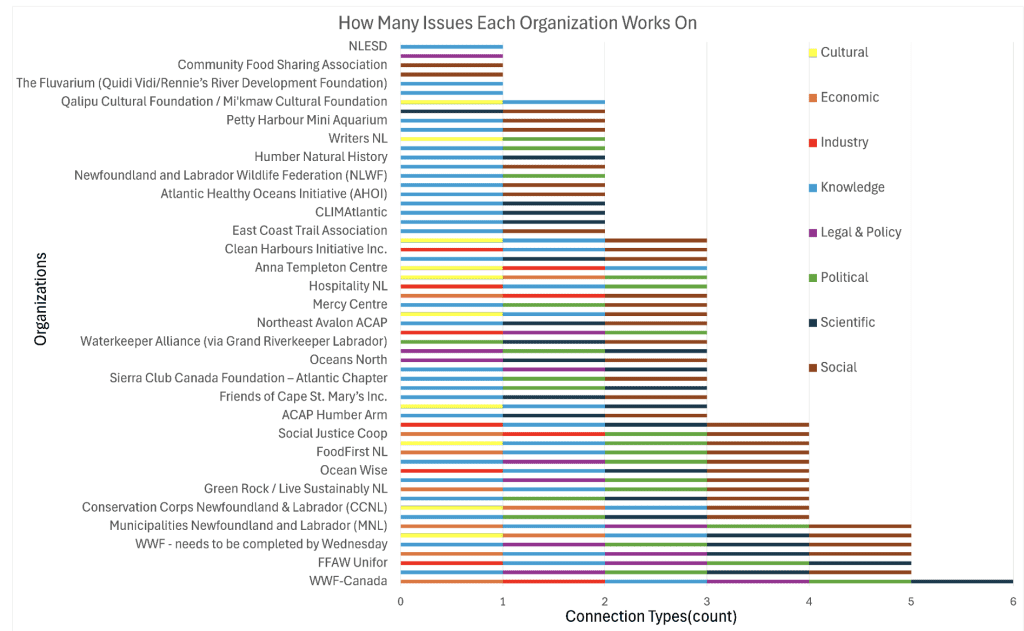
Figure 2: The Social Network Map
A map showing how organizations connect through shared work.
Why these clusters were created and how communities can use them
The clusters were created to make a complex landscape of organizations easier to understand and use. Rather than asking communities to sort through a long list of NGOs one by one, clustering groups organizations that work in similar ways based on the types of connections they focus on, such as policy, science, culture, stewardship, education, or economic development. For communities, this means they can start by looking at the cluster that best matches their priorities and quickly identify organizations that are likely to be relevant partners. The clusters help communities see where natural allies exist, where different kinds of expertise can be brought together, and where gaps or missing connections may require new partnerships or creative approaches. NGOs can use it to identify collaborators, expand outreach, share resources, and reduce duplication, while governments can use it to support more coordinated efforts, engage a wider range of partners, and better understand community networks when planning initiatives. This matters because marine conservation in Newfoundland and Labrador is not only about protecting ecosystems, it is also about livelihoods, culture, food security, community identity, and the well-being of future generations, all of which depend on strong and visible connections between people and organizations.
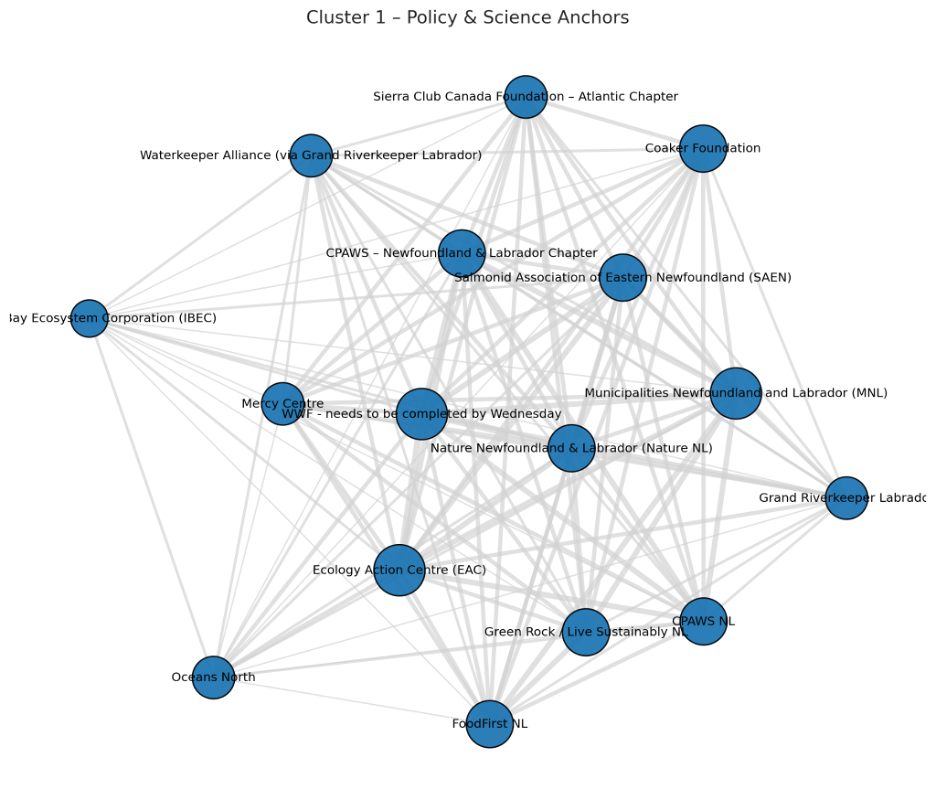
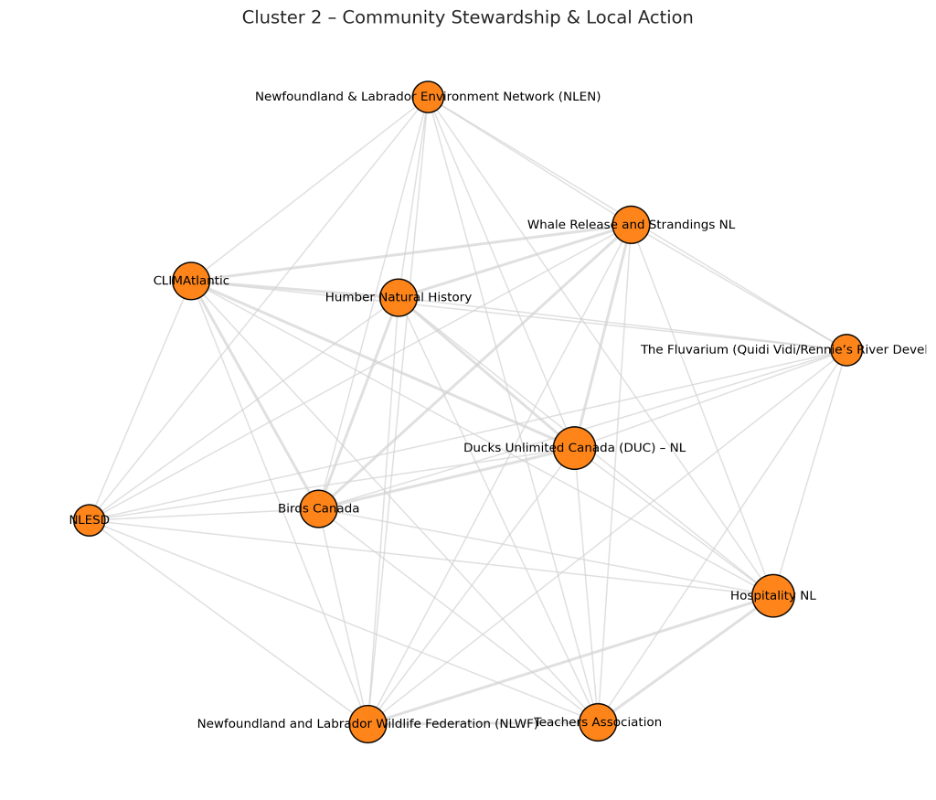
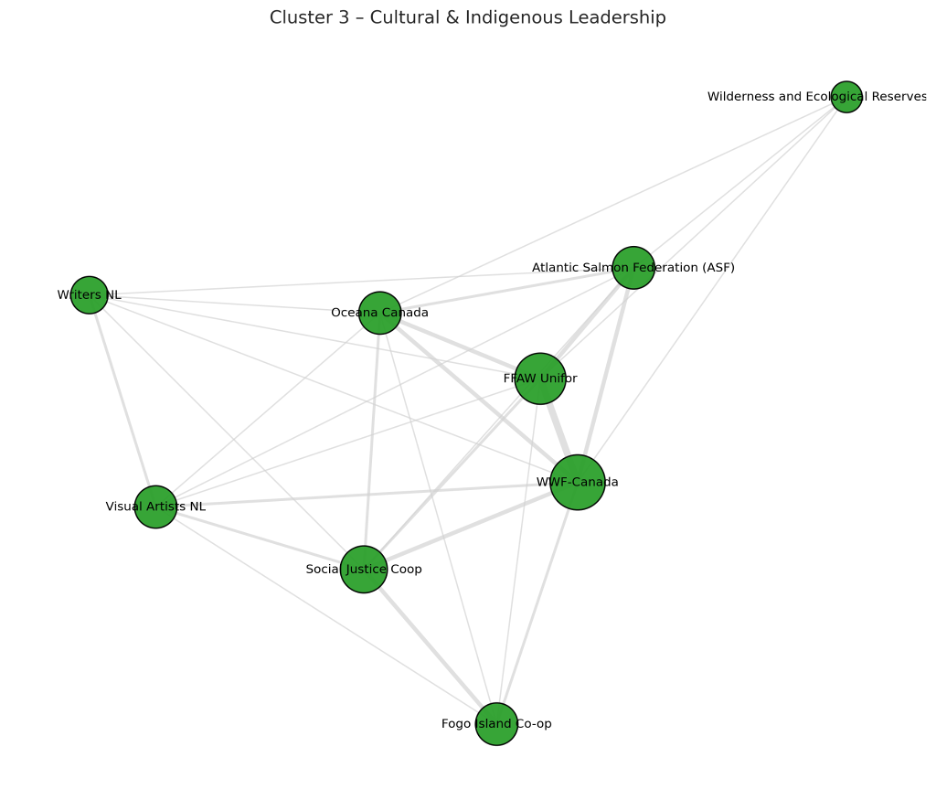
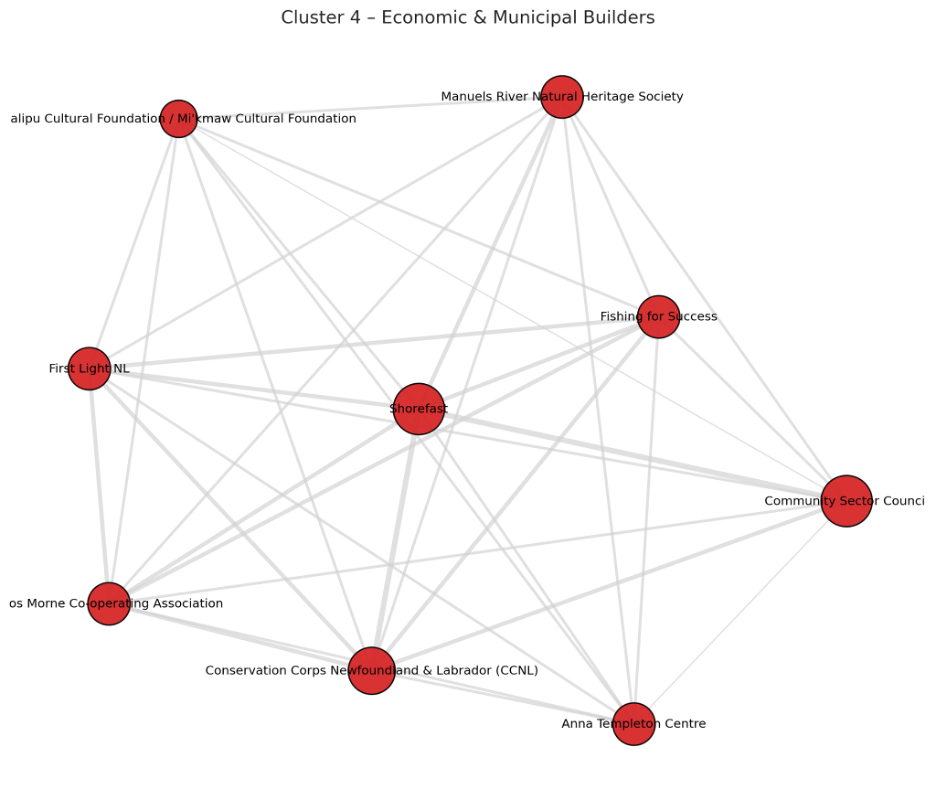
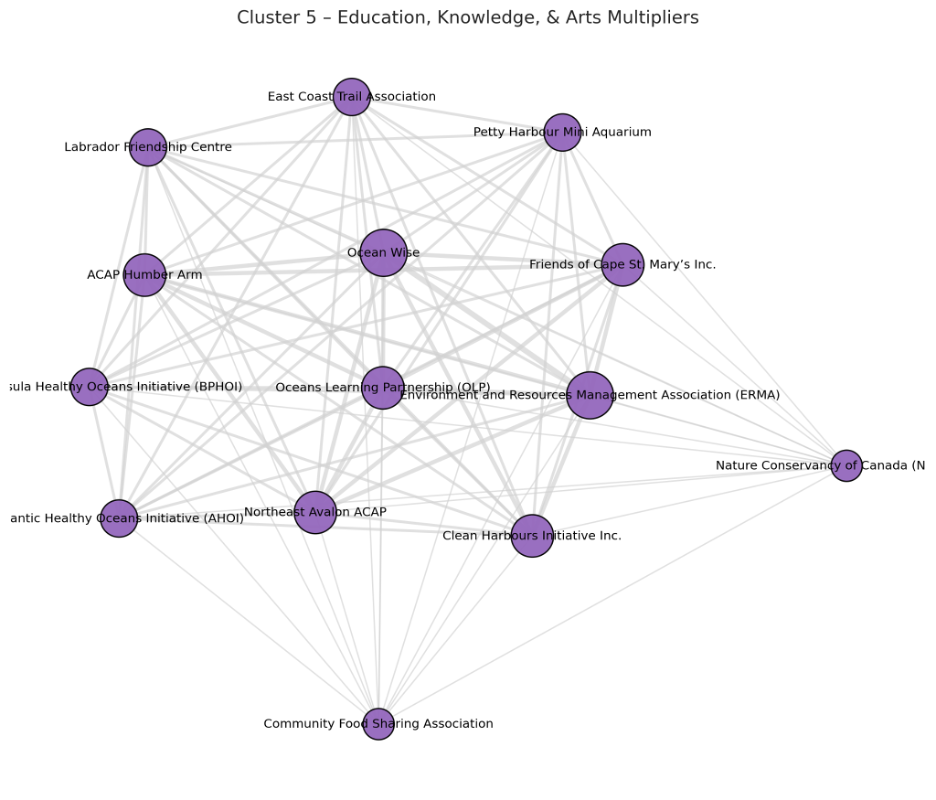
In the cluster maps, each dot represents an organization, the lines show shared focus areas, larger dots indicate broader mandates, and thicker lines reflect stronger overlaps in work.
Cluster 1: Policy & Science Anchors
Many decisions about marine conservation are shaped by research, regulation, and policy processes that can feel distant from communities. This cluster highlights organizations that work at this interface, connecting scientific evidence with policy and advocacy.
The connections in this network reflect shared efforts around research, regulation, and influencing decision-making. Communities may find this cluster especially useful when they are seeking support with policy engagement, scientific evidence, or broader advocacy efforts.
Cluster 2: Community Stewardship & Local Action
In many coastal communities, marine conservation is not an abstract idea but part of daily life on the land and water. This cluster brings together organizations whose work is rooted in hands-on stewardship, local monitoring, restoration, and community programs. The connections in this network highlight shared involvement in place-based action and long-standing relationships with specific regions. Communities may turn to this cluster when they are looking for partners who can support practical, locally grounded conservation work.
Cluster 3: Cultural & Indigenous Leadership
Conservation in this network is shaped by relationships to land, sea, and community that extend beyond policy or project boundaries. The organizations in this cluster approach marine conservation through cultural responsibility, Indigenous leadership, and commitments to social justice. Rather than treating culture as an add-on, their work is rooted in knowledge systems, lived histories, and community identity. This cluster can help communities identify partners whose approaches to conservation are guided by Indigenous knowledge, cultural continuity, and inclusive ways of working.
Cluster 4: Economic & Municipal Builders
Conservation efforts are often closely tied to questions of livelihoods, local economies, and community governance. This cluster highlights organizations that work at the intersection of marine conservation, economic development, and municipal or community planning. The connections in this network reflect shared interests in community viability, local decision-making, and economic realities. Communities may find this cluster useful when exploring conservation initiatives alongside employment, tourism, municipal planning, or broader community development goals.
Cluster 5: Education, Knowledge, & Arts Multipliers
Ideas about marine conservation travel through classrooms, public spaces, stories, and creative expression. This cluster highlights organizations that focus on education, communication, outreach, and the arts as ways to broaden understanding and engagement. The connections in this network show how knowledge and ideas are shared, translated, and amplified across communities. This cluster may be particularly useful for those looking to support learning, youth engagement, or creative pathways into marine conservation.
Understanding the network of organizations working in these areas can help everyone
By making connections visible, these maps respond directly to the question communities asked us: who can help, and how can we work together? Rather than navigating marine conservation alone, communities can now see the broader network of organizations, identify natural allies, and build partnerships that reflect their values, priorities, and lived realities. We invite communities, NGOs, and governments to explore the maps, share their experiences, and help this resource grow. Together, we can strengthen relationships, reduce fragmentation, and support a more inclusive and community-centered approach to marine conservation in Newfoundland and Labrador.


